
The short answer
Color change is developmental, but its timing is not universal.
Green tree pythons are well known for ontogenetic color change: a transition associated with growth from neonatal coloration toward adult appearance. Neonates may be yellow, red, or red-brown, while adults are commonly green with individual variation in shade and markings.1, 2
Smithsonian’s National Zoo describes a broad six-to-twelve-month window. A field study reported yellow-to-green change between 53 and 59 centimeters and at approximately one year of age in the population it examined.1, 3 Those figures are useful biological context—not a deadline for every captive animal.
01 · The term
What does “ontogenetic color change” mean?
Ontogeny is the development of an individual organism through its life. Ontogenetic color change therefore means a change in coloration associated with development—not a short-lived response to mood, lighting, temperature, or the normal dullness that can precede shedding.
For green tree pythons, the phrase most often refers to the conspicuous transition from red or yellow neonatal coloration toward an adult appearance dominated by green. Scientific work has examined that transition alongside growth, habitat use, foraging, prey selection, head shape, and maturity.3, 5
02 · Timing
When do green tree pythons turn green?
The most accurate answer is: during development, with timing that can vary. Smithsonian offers a general six-to-twelve-month description. In one mark-recapture field study, the major yellow-to-green transition occurred between 53 and 59 centimeters and was estimated at approximately one year based on the studied animals’ growth rates.1, 3
That does not establish a universal captive schedule. A result from a particular wild population should not be converted into a promise that every captive animal will begin, complete, or display color change at the same age or size. Development records are more useful when they preserve dates, age or hatch information when known, photographs under comparable lighting, and notes about which observations are confirmed.
03 · Neonatal color
Red versus yellow baby green tree pythons.
Peer-reviewed research describes neonates hatching in both red and yellow color forms, and Smithsonian also describes bright yellow, red, and red-brown juveniles.1, 4 These starting colors are part of the species’ developmental biology; they should not be treated as a simple chart for predicting one exact adult outcome.
Sora, a male from Pluto × Siren, provides a confirmed same-animal example from the Kinghorn Chondros collection. The photographs below record his appearance at two weeks, eight months, and twelve months.
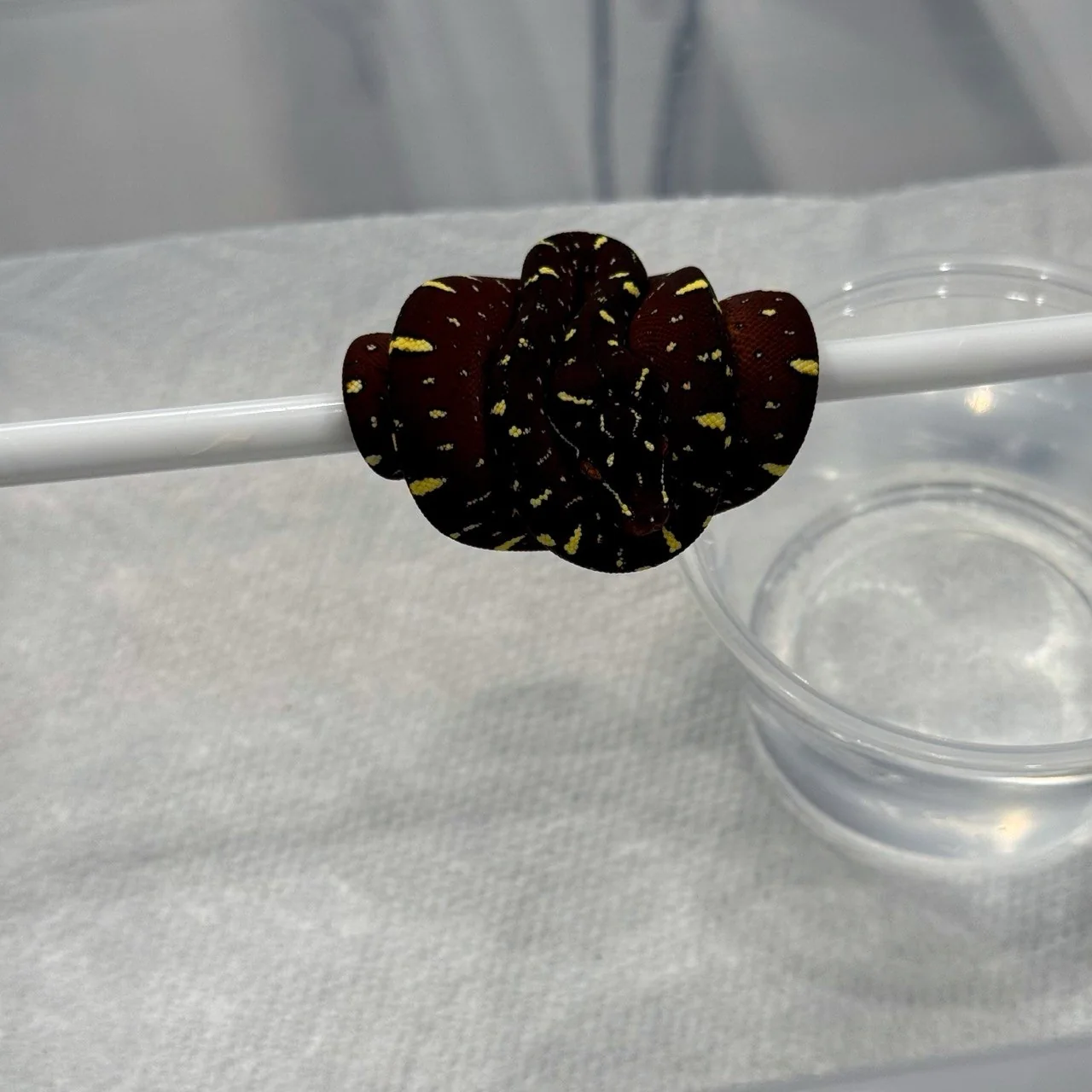
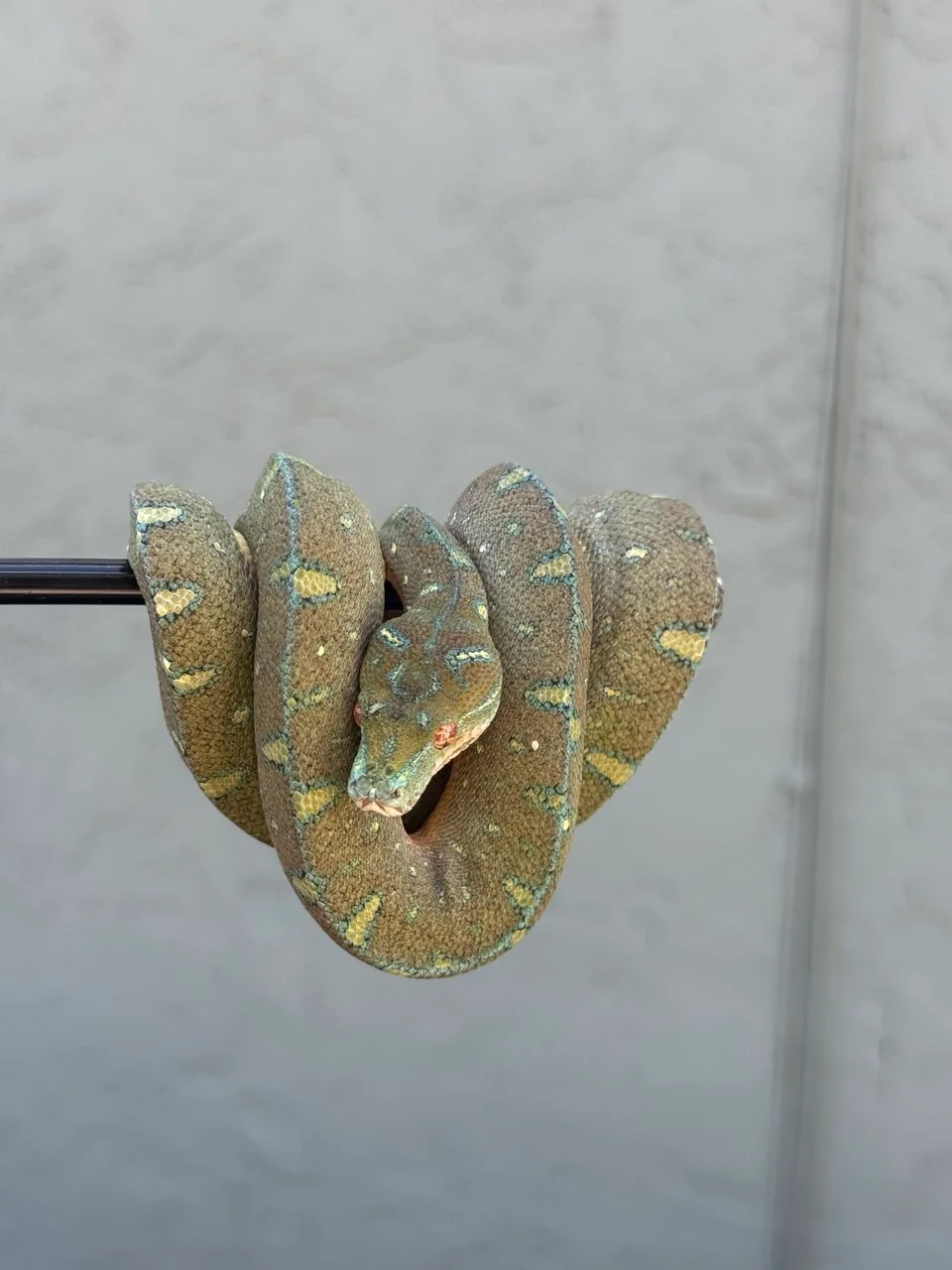
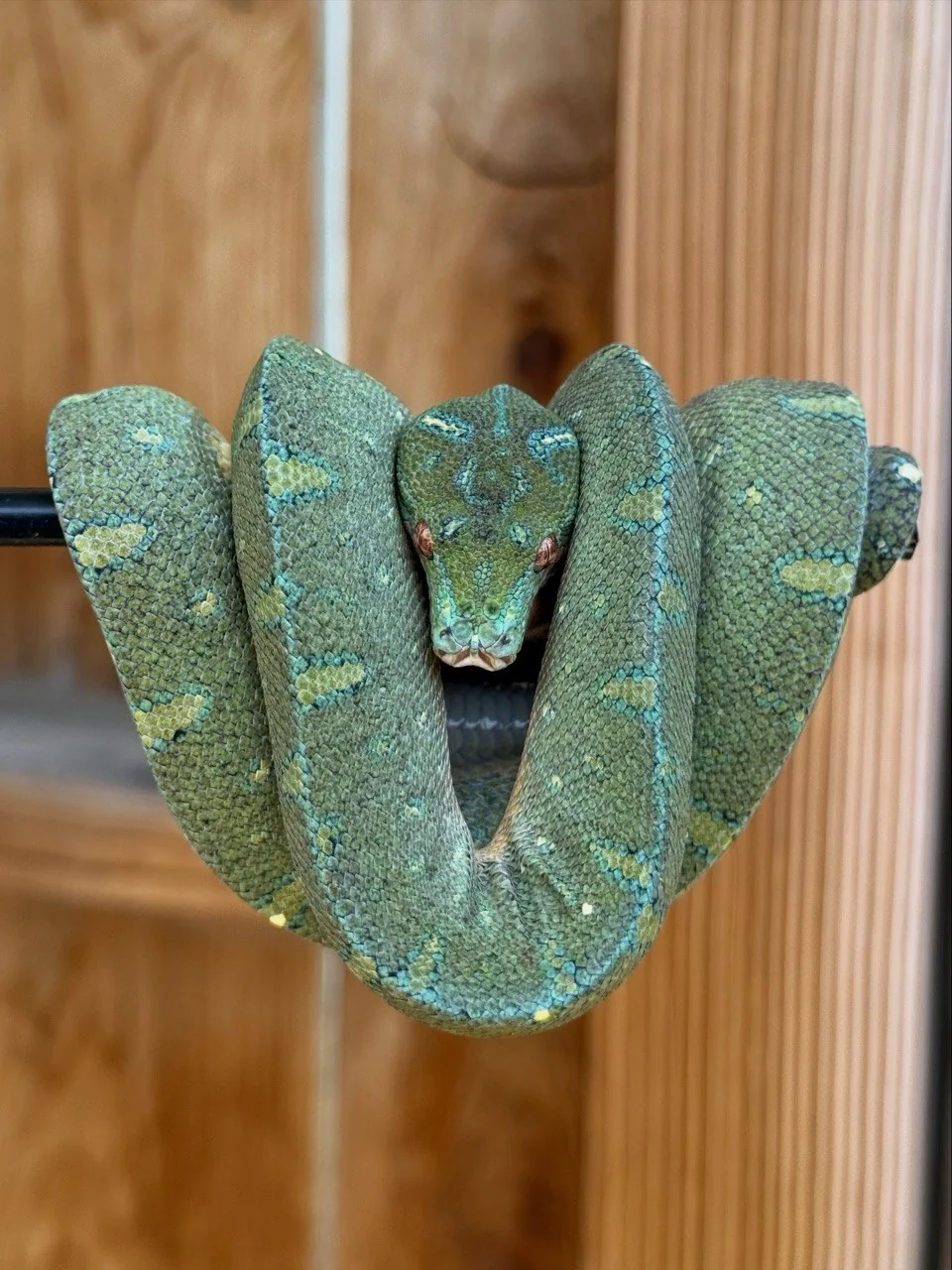
Same-animal record: all three photographs show Sora at owner-confirmed ages. Lighting, background, and camera conditions differ, so the images document real milestones without serving as a universal timetable or exact color reference.
Aurora: 2 to 14 months
Aurora, a female with recorded lineage (Wrangler × Mercury) × (Kronos × Siren), provides a second confirmed same-animal record. The sequence follows her observed appearance at two, four, six, ten, and fourteen months.
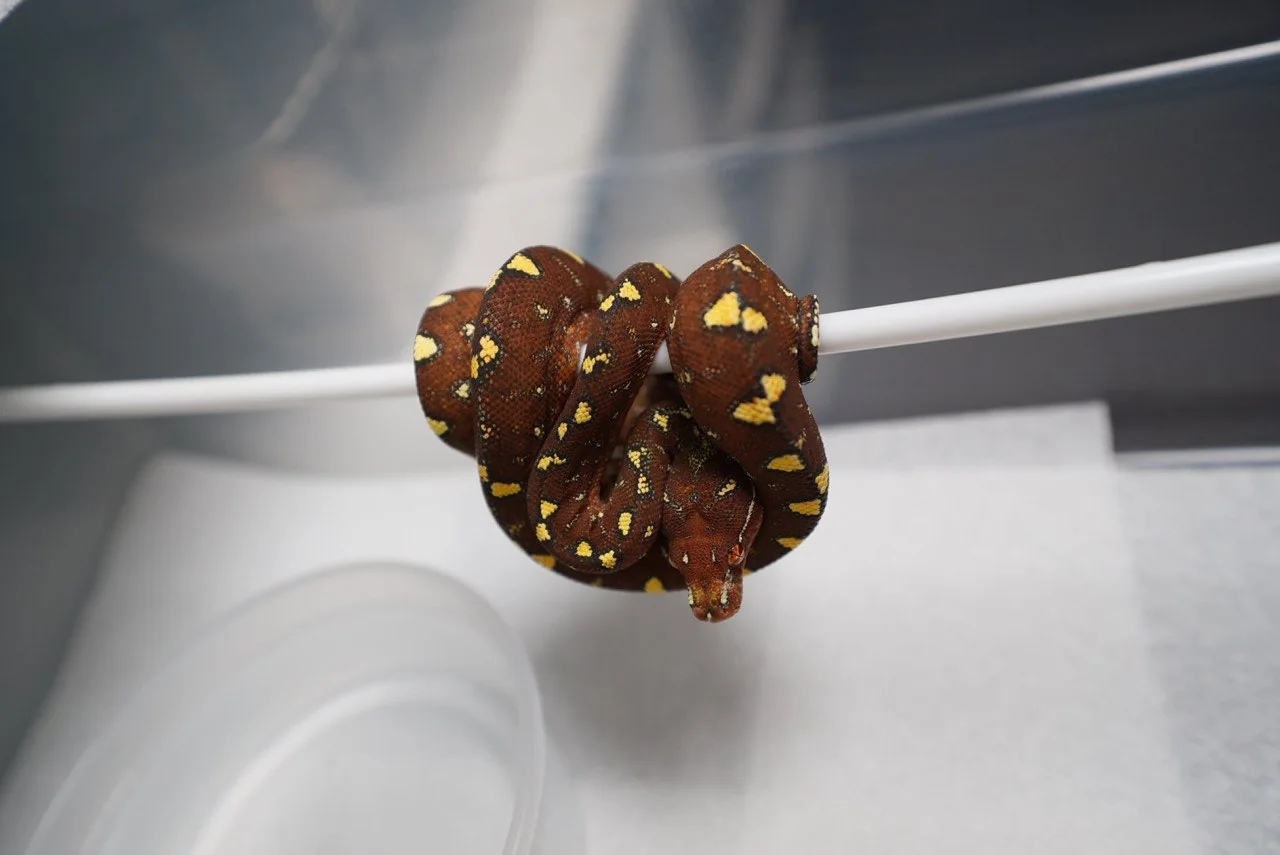
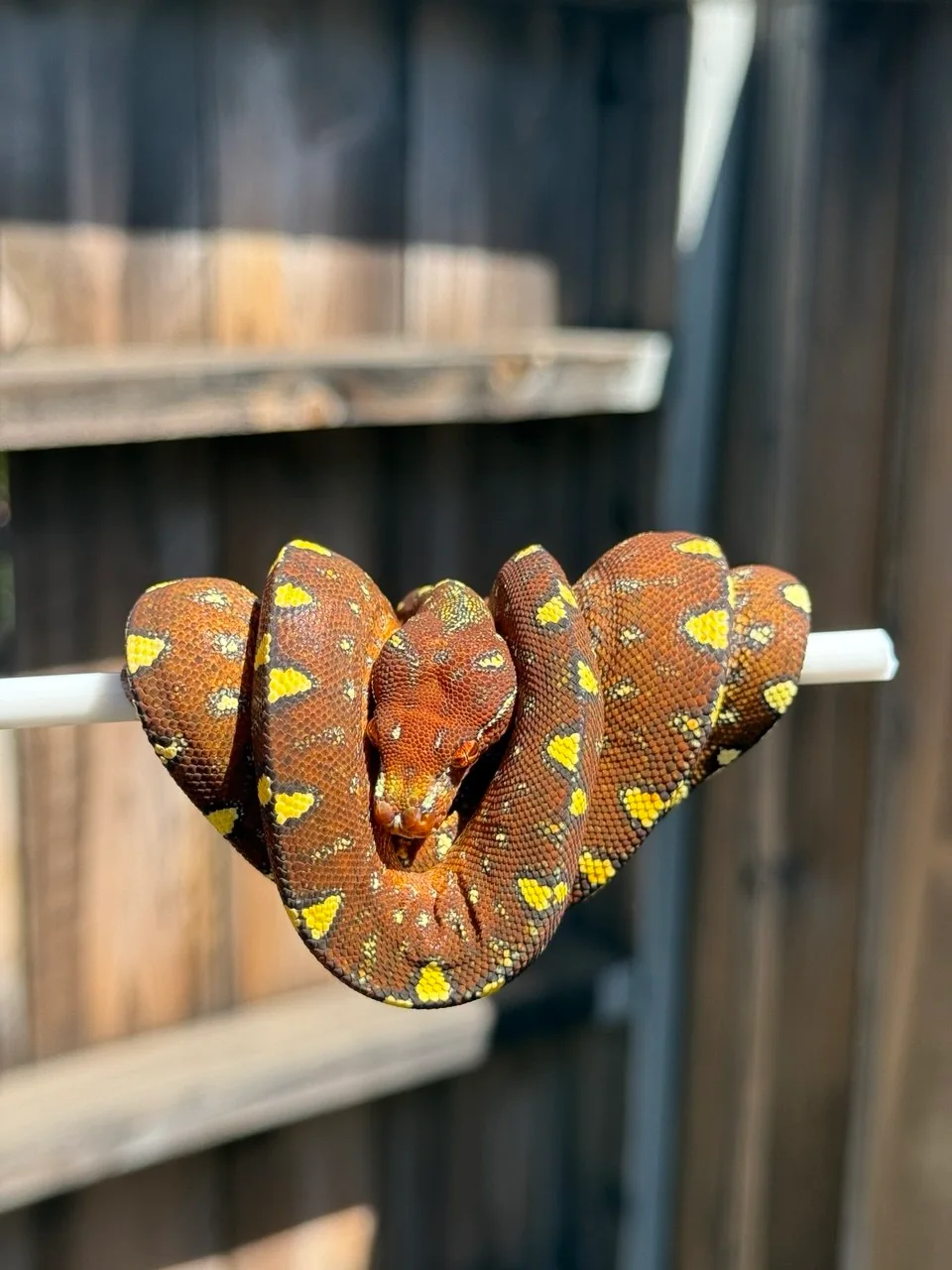
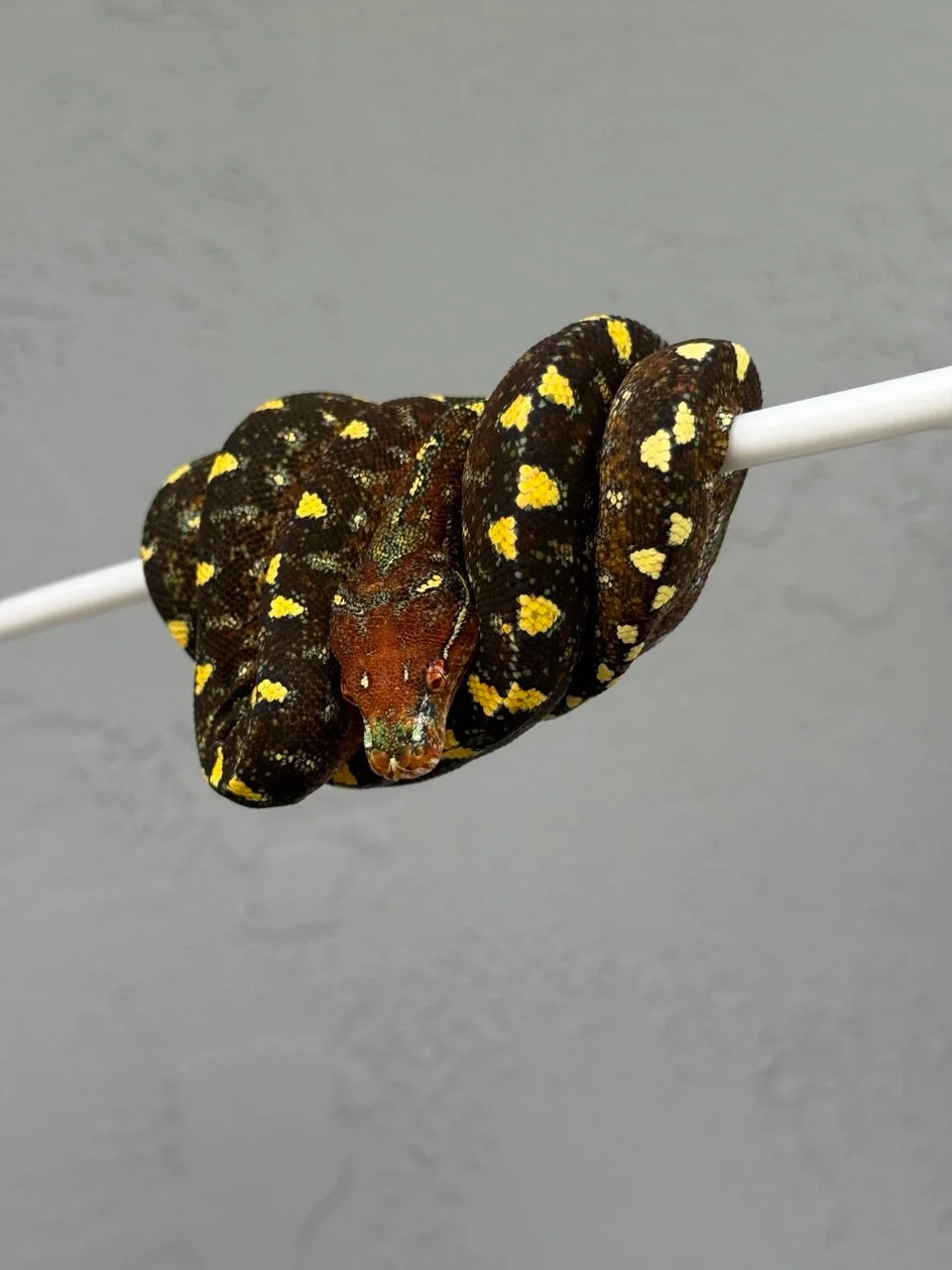
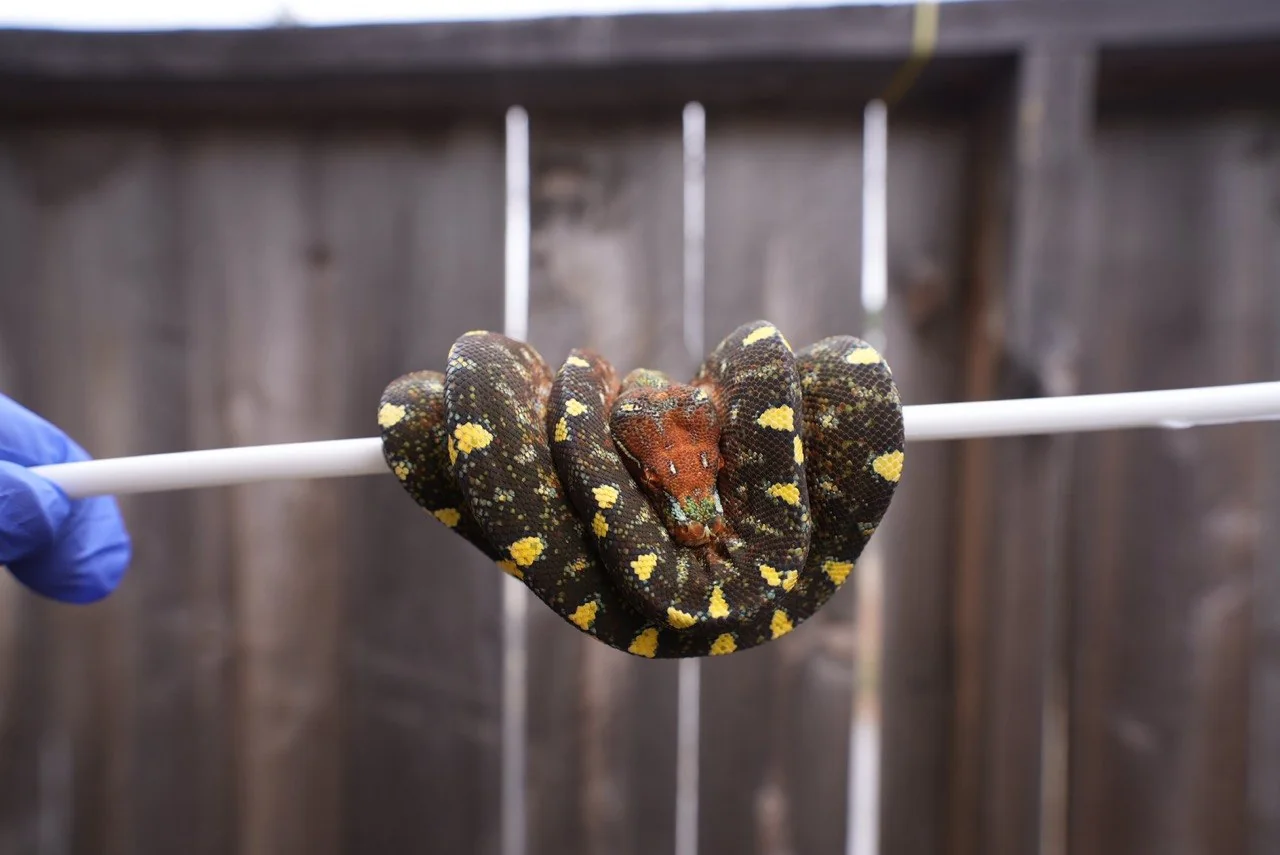
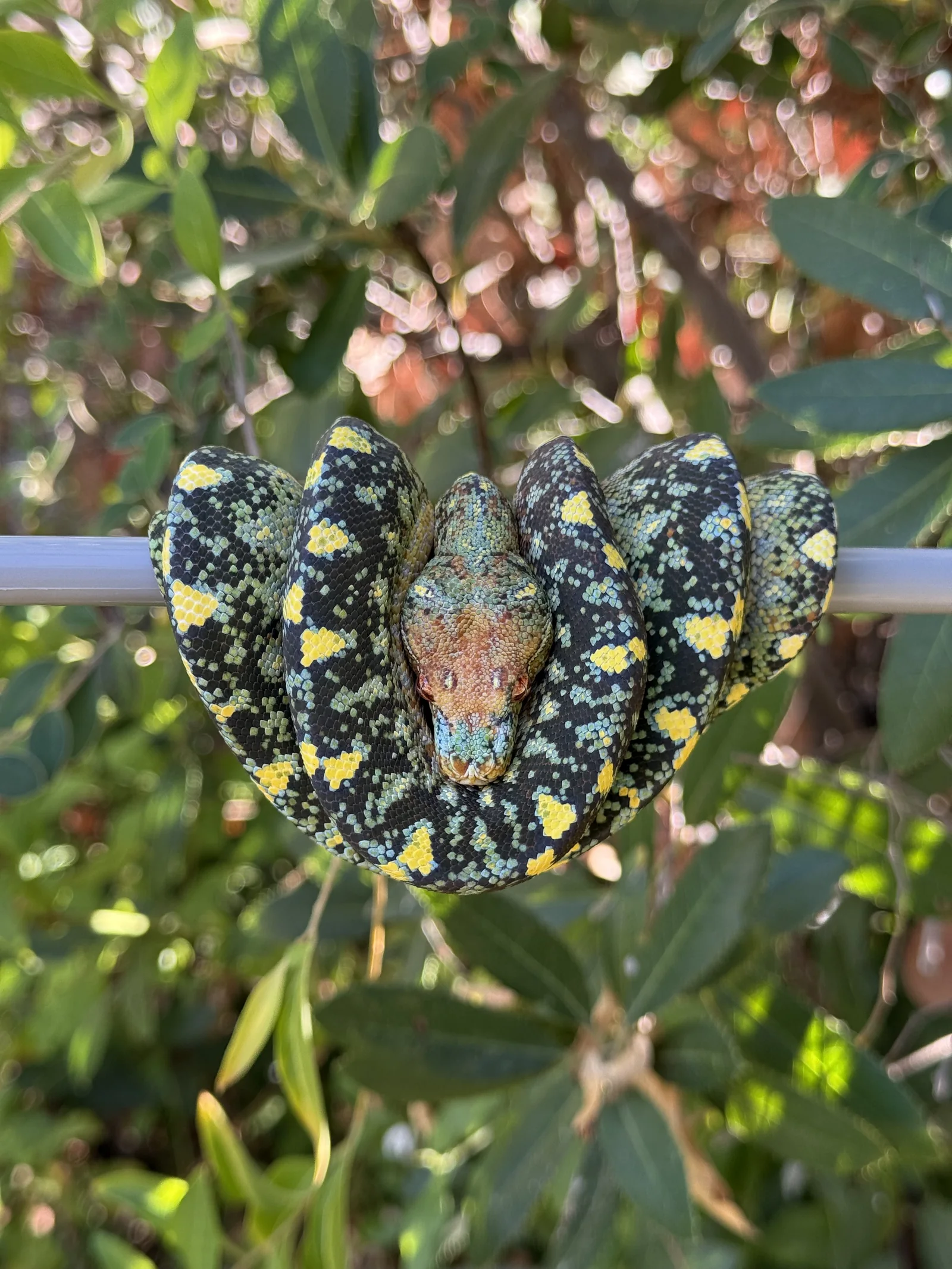
Same-animal record: all five published photographs show Aurora at owner-confirmed ages. Lighting, background, and camera conditions differ, so apparent color should be compared cautiously.
04 · Ecology
Why does the color change occur?
A 2007 study tested coloration from the perspective of visually oriented avian predators. Its findings supported an adaptive camouflage explanation: red or yellow juveniles and green adults were better matched to the different habitats they used as their behavior, vulnerability, and foraging ecology changed.4
That ecological explanation describes patterns in studied wild animals. It does not mean that the color of a captive neonate reveals its exact future phenotype, geographic origin, or pedigree. Appearance, documented ancestry, locality, and breeder terminology remain different categories. Our designer green tree python guide explains those distinctions.
05 · A separate process
Does color change happen during a shed?
The 2006 field study reported that the major yellow-to-green transition in its studied population happened rapidly without an associated shedding of skin.3 That finding distinguishes ontogenetic transition from the temporary dull or muted appearance often seen before a normal shed.
Photographs can also look different because of lighting, white balance, camera processing, enclosure surfaces, or staining. A sudden or concerning change accompanied by abnormal behavior, physical changes, or other health signs should not be diagnosed from an online color chart. An experienced reptile veterinarian is the appropriate resource for an individual health concern.
06 · Documentation
A trustworthy color-change record follows one animal over time.
The most useful progression record uses the same identified animal, dated photographs, age or hatch information when known, comparable lighting, and clear separation between observed facts and predictions. Images of parents, siblings, or unrelated examples can add context, but they are not substitutes for a same-animal timeline.
Identify the animal. Keep each image attached to the correct individual record.
Preserve dates. Record the photograph date and age or hatch date when confirmed.
Control the comparison. Note substantial differences in lighting, editing, camera, and enclosure conditions.
Separate record from expectation. Label current phenotype, documented ancestry, and any uncertain prediction independently.
Frequently asked
Green tree python color-change questions.
When do green tree pythons change color?
There is no universal captive timetable. Smithsonian gives a general six-to-twelve-month description, while one field study observed yellow-to-green change at 53–59 centimeters and around one year of age in its studied wild population. Individual timing can vary, and population-level results should not be used as a deadline for a captive animal.
Why do green tree pythons change color?
Research on wild green tree pythons supports a camouflage explanation associated with changes in habitat use, foraging behavior, size, and vulnerability as the animals develop. This is an ecological explanation, not a method for predicting the exact adult appearance of an individual captive animal.
Are baby green tree pythons red or yellow?
Published research describes both red and yellow neonatal coloration. Starting color alone should not be treated as a reliable guarantee of exact adult color or pattern.
Does a green tree python have to shed to change color?
A field study reported that the major yellow-to-green transition in its studied population occurred rapidly without an associated shed. Normal pre-shed dullness is a different phenomenon from ontogenetic color change.
Do all green tree pythons become exactly the same green?
No. Green tree pythons are known for development toward adult green coloration, but adult shade, blue or yellow expression, white markings, pattern, and the timing of change can vary. A neonate photograph or pedigree does not guarantee one exact adult result.
Sources
Research and further reading.
- Smithsonian’s National Zoo — Green tree python. Institutional species profile describing neonatal colors and a general six-to-twelve-month transition.
- Animal Diversity Web — Morelia viridis. Species account discussing ontogenetic color change and developmental ecology.
- Wilson, Heinsohn & Endler (2006), Life-history traits and ontogenetic colour change in an arboreal tropical python, Morelia viridis, Journal of Zoology.
- Wilson, Heinsohn & Endler (2007), The adaptive significance of ontogenetic colour change in a tropical python, Biology Letters.
- Natusch & Lyons (2012), Relationships between ontogenetic changes in prey selection, head shape, sexual maturity, and colour in an Australasian python, Biological Journal of the Linnean Society.